Operating department practitioner abroad: where your registration can lead
Only the UK registers operating department practitioners. What the HCPC reads, what the visa data says, and why other countries are not on our map.
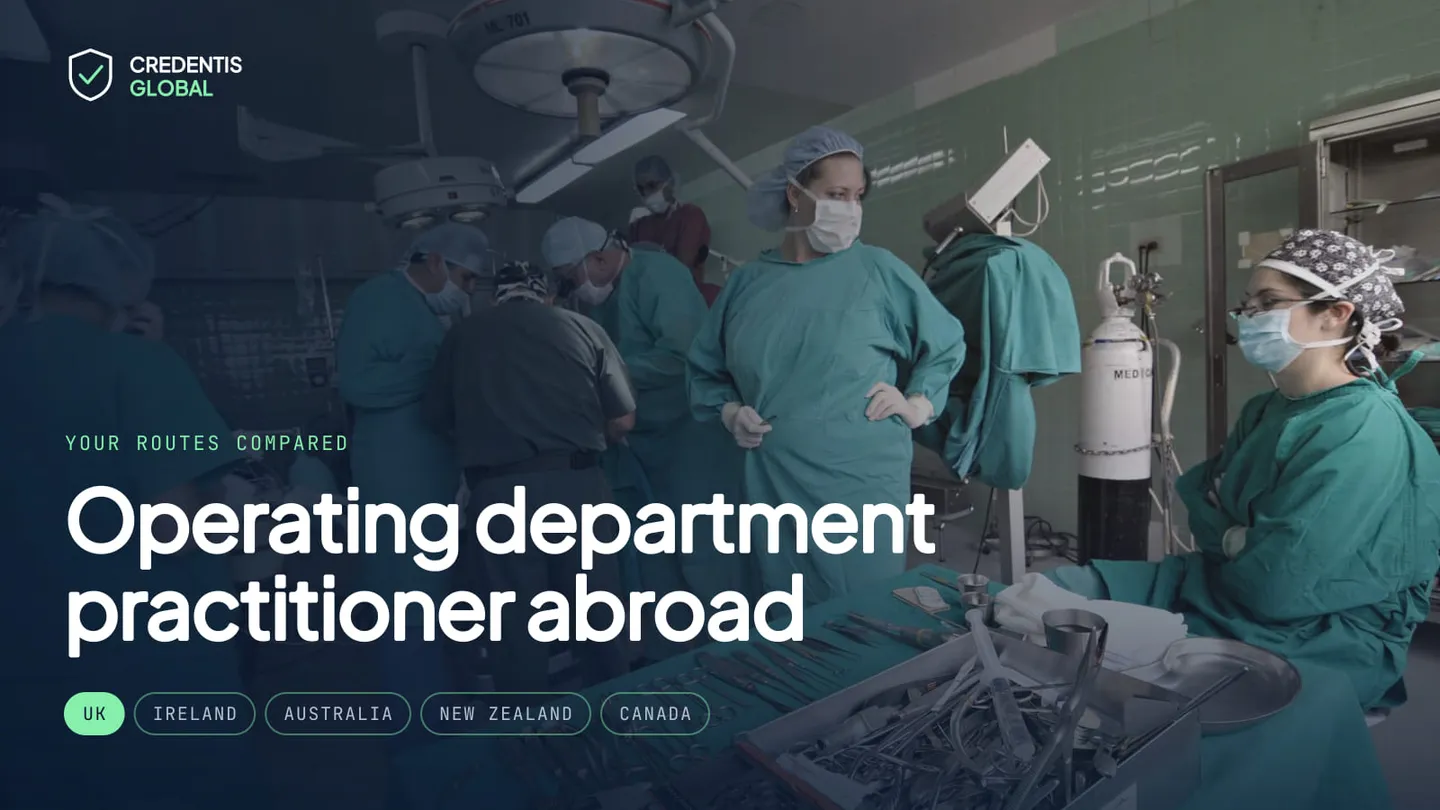
Only the UK registers operating department practitioners, and the regulator is the HCPC (the Health and Care Professions Council). Of the five countries we file in, no other holds a register for the title.
Operating department practitioner is a British title, so this is a short map with one road on it. Ireland, New Zealand, Australia and Canada do not register it.
That is why the one road, and the visa data beside it, are worth reading carefully before you plan around any other country.
A title most countries do not use
The HCPC describes the work in a single line. Operating department practitioners:
provide individualised care and skilled support alongside medical and nursing colleagues during the anaesthetic, surgical and recovery phases
Source: hcpc-uk.org · Professions and protected titles · 2026-10-04
Outside the UK, your course will almost certainly carry a different name. The register uses its own, and Operating department practitioner is a protected title, so your file should show how your training covers all three phases: anaesthetic, surgical and recovery.
Source: hcpc-uk.org · Standards of proficiency - Operating department practitioners · 2026-10-04
The UK route, step by step
The HCPC runs one international route for every profession it registers. In order:
- Check you are eligible: trained and qualified outside the UK, in a qualification that relates to an HCPC profession, and never registered with the HCPC before.
- Prepare every document and have each copy certified by a person of standing in the community.
- Open an online account and start an international application.
- Complete each section, including the standards of proficiency mapping document and the declarations.
- Submit, and wait for the HCPC’s checks and assessment.
- Receive its first decision by email.
Source: hcpc-uk.org · How to apply via the international application route · Eligibility to apply for registration · 2026-10-04
What the HCPC reads
The assessment holds your education, training and experience against the Standards of proficiency for operating department practitioners. The mapping document is where you show, standard by standard, where your training met each one.
The HCPC also checks that copies are correctly certified, that uploads are machine-readable, and that documents not in English come with a certified official translation. It runs plagiarism and AI checks on what you submit.
Source: hcpc-uk.org · Documents you need to prepare and certify · What to expect when you make an international application · 2026-10-04
The documents it names are short in number: proof of identity and address, a course information form with your qualification certificate, an English certificate, the mapping document and a declaration.
The course information form describes your programme, not you, so it usually needs your college’s help. Ask for it early; the application cannot move until it is back.
For English, the HCPC lists no profession-specific OET for operating department practitioners. IELTS at 7.0 with no element below 6.5, or TOEFL at the level it sets, are the usual evidence.
Source: hcpc-uk.org · Certificate of English language proficiency · 2026-10-04
After the first decision
There are three possible outcomes: successful, a test of competence, or unsuccessful. If you are asked to take a test of competence, expect a structured professional discussion with two registrants rather than a written paper.
If the application is refused, the HCPC emails its reasons with a Record of Assessment. You can appeal a panel decision or apply again.
Read that record closely if it comes. It sets out how the assessors saw your evidence against the standards, which is the starting point for any second attempt.
Source: hcpc-uk.org · Possible outcomes of your international application ('first decision') · Refused applications · 2026-10-04
Why the other four countries are not recorded
Ireland does not regulate the title. New Zealand and Australia have a nearest equivalent, the anaesthetic technician, which is a different occupation with its own rules; we label it nearest equivalent every time, because it is not the same job.
Source: coru.ie · immigration.govt.nz · jobsandskills.gov.au · Registration Boards · Green List roles · Occupation Shortage List 2025 · 2026-09-22
New Zealand lists Anaesthetic Technician at Tier 1 on its Green List, and Australia rates Anaesthetic Technicians in shortage. Canada does not include the role in its Express Entry healthcare category. None of these is a registration route our registry records for an ODP.
The New Zealand numbers show the nearest equivalent is real work for overseas-trained people. In the year to March 2025 the Medical Sciences Council registered 76 internationally qualified anaesthetic technicians, nearest equivalent to ODP, beside 25 New Zealand graduates. Immigration New Zealand counts 126 Accredited Employer Work Visa approvals for the same occupation since that visa opened.
Source: mscouncil.org.nz · immigration.govt.nz · Annual Report 2025 · AEWV data report, Table 5 · 2026-10-04
That is a different register, with its own standards, which we have not mapped into a route. Treat it as a pointer, not a plan.
What the demand data shows
The UK signal is mixed, and we would rather you heard it from us now. The NHS Long Term Workforce Plan names operating department practice among the greatest allied health shortfalls and plans to raise training places by at least 80%.
Source: england.nhs.uk · NHS Long Term Workforce Plan, June 2023 · 2026-09-22
But the Health and Care Worker visa is open to this occupation for extensions and switches only. It is closed to new applicants.
Source: gov.uk · Health and Care Worker visa eligible occupations · 2026-09-22
Registration with the HCPC and permission to work in the UK are separate questions. The first is the regulator’s; the second is the Home Office’s, and its rules change.
HCPC registrants who joined through the international route
Unit: registrants
| Category | International route, 19 Apr 2024 |
|---|---|
| Physiotherapists | 16,093 |
| Radiographers | 12,075 |
| Biomedical scientists | 5,496 |
| Occupational therapists | 3,630 |
| Dietitians | 1,716 |
| Speech and language therapists | 1,223 |
| Operating department practitioners | 951 |
| Chiropodists/podiatrists | 196 |
At the April 2024 snapshot, 951 operating department practitioners on the register had joined through the international route. That is a small share beside physiotherapy or radiography.
HCPC-registered operating department practitioners
18,200 registrants
Operating department practitioners · Registrants, 1 Sep 2026
Before you commit to the UK
- Read the visa position first. Registration can be granted while the visa you hoped to use stays closed to new applicants.
- Map all three phases. A file that shows only theatre assistance, without anaesthetic and recovery work, leaves the assessor with questions.
- Expect a conversation, possibly. A test of competence is a discussion with two registrants, so be ready to talk through your own cases.
Sources
The HCPC facts above were read on hcpc-uk.org on 4 October 2026; the demand facts on 22 September 2026. Dated facts for operating department practitioners are on our sources page.
What to do first
- Ask your college for the syllabus of your batch, with theory and theatre hours.
- Get each hospital to describe your role across anaesthetic, surgical and recovery work.
- Collect your degree, every transcript and any registration you hold where you trained.
- Read the current visa position for new applicants before you plan around the UK.
The Route Finder below shows this route’s fees and timelines.
What we do
How Credentis Global helps with this route
You trained. We file. The regulator decides. Here is what that means for your file.
Your fit, read before anything is filed
we read your degree, transcripts and experience against the regulator’s published standard first, so you know where the file is strong and where it needs evidence.
Every document, in the order the regulator reads it
Each item is checked against the regulator’s own list: names matched to your passport, hours in writing, copies certified by the person the list names.
One portal, and a person who answers
Upload your documents, see every stage of the file and message us in one place. The person who replies is the specialist preparing your file.
We prepare and file. The regulator decides.
Your application goes in from your own regulator account with every page prepared, and every query is drafted against the regulator’s exact question.
One specialist owns your file
The specialist who reads your documents builds the file and answers the regulator’s queries. You always know who has it, and you pay the regulator directly.