What New Zealand's boards check before they register you
Each New Zealand board reads overseas qualifications its own way. The steps, standards and documents they name, and what follows a decision.
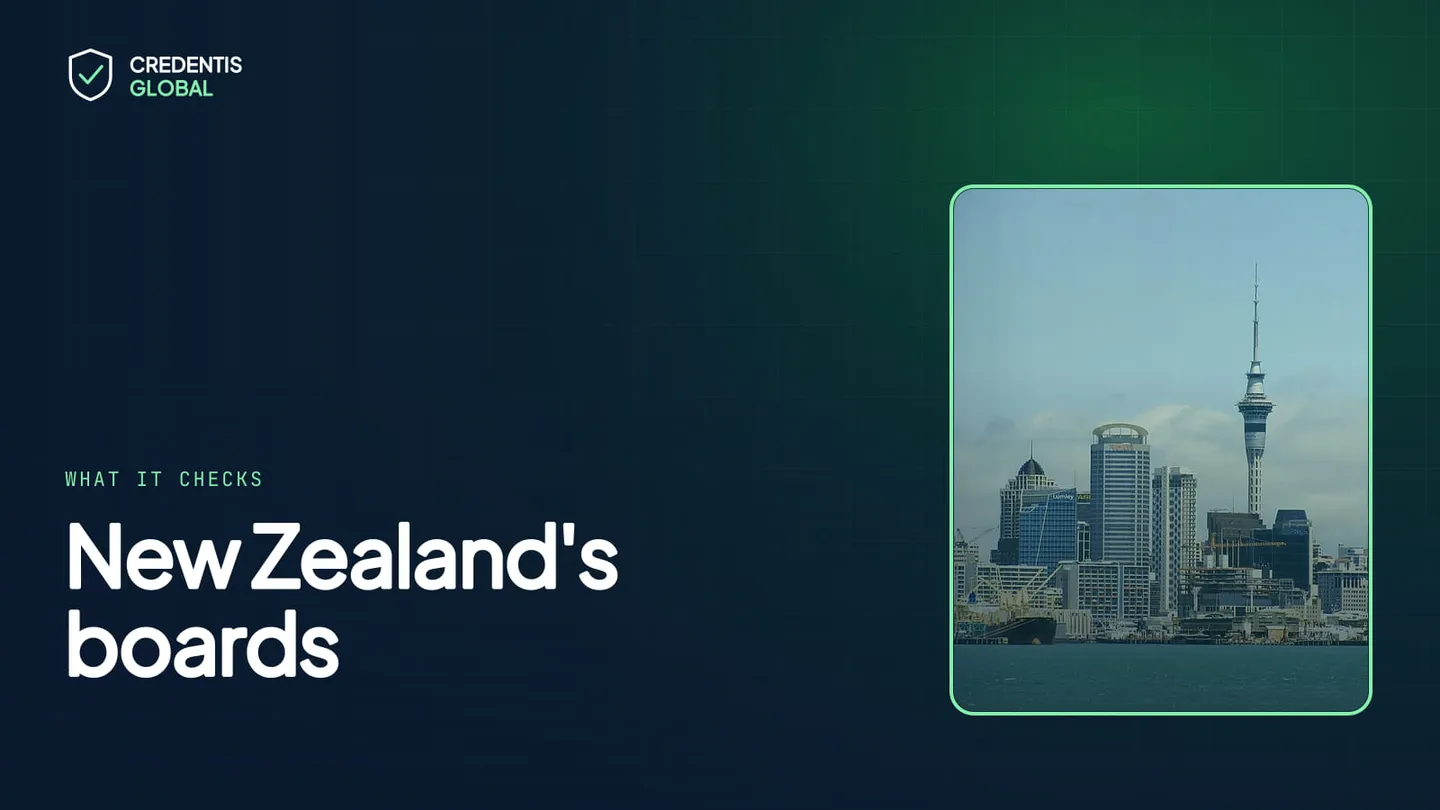
There is no single New Zealand regulator to study. There are eight bodies whose overseas routes we have read for the professions on this site, seven boards and one association, and each one writes its own rules for overseas applicants.
What they share is a way of thinking. This post sets out that common thread, then what each body adds to it.
Three checks, many boards
Every board asks the same three questions in its own words:
- Is your qualification equivalent to the New Zealand standard for the profession?
- Can you be registered with this board, and in which scope of practice?
- What does the visa side need? For Green List roles, a job offer is what opens Straight to Residence.
Source: immigration.govt.nz · as recorded in our regulator registry · Sept 2026
A board also registers you in a named scope, such as Medical Imaging Technologist or Provisional Optometrist. The scope sets what you may do, so check its name against the work you plan.
The first two belong to the board. The third belongs to Immigration New Zealand, and no board decision makes it for you.
How a board reads your qualification
Most boards assess equivalence on paper. The Medical Radiation Technologists Board puts it this way:
Your qualifications and experience will be assessed to determine if they are equivalent or satisfactory as an approved New Zealand qualification for that scope of practice.
Source: mrtboard.org.nz · Internationally qualified - How to register · 2026-10-04
Where the answer is no, several boards can offer an examination instead of a refusal. The Medical Sciences Council and the MRTB both say so. The Podiatrists Board can add a practical assessment, and the optical board relies on exams run by OCANZ and ADONZ.
Source: mscouncil.org.nz · podiatristsboard.org.nz · odob.health.nz · Internationally Qualified Registration: Medical Laboratory Scientist · Candidate Guide · Registration Pathways from accredited prescribed qualifications · 2026-10-04
Board by board
Physiotherapy Board. Two routes. The Express Pathway is for holders of unrestricted registration in the UK, Ireland, Canada or South Africa. The General Pathway assesses your primary degree’s curriculum against the Physiotherapy Practice Thresholds, and asks for more evidence where a competency falls short.
Occupational Therapy Board. Board-appointed occupational therapists assess each qualification individually. You complete a desktop competence self-assessment, confirmed by a referee who is an occupational therapist.
Medical Radiation Technologists Board. An eligibility check form comes first, then assessment for the Medical Imaging Technologist scope against its competence standards.
Medical Sciences Council. Assessment against its competence standards, case by case:
Your application will be considered on a case-by-case basis.
Source: physioboard.org.nz · otboard.org.nz · mrtboard.org.nz · mscouncil.org.nz · International General Pathway · Overseas qualified practitioners · Internationally qualified registration · Internationally Qualified Registration: Medical Laboratory Scientist · 2026-10-04
Dietitians Board. Four pathways, decided by where you are registered now, with exams for most overseas applicants and a provisional scope for all.
Optometrists and Dispensing Opticians Board. An OCANZ exam pass for optometrists; a prescribed qualification or the CODE, sat in New Zealand, for dispensing opticians.
Podiatrists Board. A full desktop assessment, a practical assessment if required, and the Cultural Open Book Exam.
NZSTA. Speech-language therapy is self-regulated. A qualifications approval committee decides, and its decision is final.
Source: dietitiansboard.org.nz · odob.health.nz · podiatristsboard.org.nz · speechtherapy.org.nz · Overseas Trained Dietitians · Registration Policy · Overseas Qualification · Qualification Approval Framework · 2026-10-04
The documents boards name
The core is familiar: certified identity, qualification certificates, transcripts and, for a full assessment, the syllabus. What stands out in New Zealand is the rest.
- Good standing from every regulator you have been registered with, often sent to the board directly by the issuer.
- Police or criminal conviction checks from the countries the board specifies.
- Referees. Three for occupational therapy; one personal and one professional for lab science and imaging; referee proformas for podiatry.
- A CV, sometimes on the board’s own template.
- Cultural competency evidence, from courses each board names.
- Practice records, such as a clinical logbook or a clinical experience form.
Source: physioboard.org.nz · otboard.org.nz · mrtboard.org.nz · mscouncil.org.nz · podiatristsboard.org.nz · International General Pathway · Overseas qualified practitioners · Internationally qualified - How to register · Internationally Qualified Registration · Overseas Qualification · 2026-10-04
Where files are queried
Two boards say outright that an application cannot be submitted until every listed document is uploaded, and both ask you to watch your inbox and portal for requests for more information.
Source: mscouncil.org.nz · mrtboard.org.nz · Internationally Qualified Registration: Medical Laboratory Scientist · Internationally qualified - How to register · 2026-10-04
On the physiotherapy General Pathway, a curriculum that does not reach threshold on every key competency triggers a request for supporting evidence. NZSTA stops processing a file whose IELTS score is below its minimum.
Source: physioboard.org.nz · speechtherapy.org.nz · International General Pathway · Qualification Approval Framework · 2026-10-04
After the decision
Registration and the right to practise are separate. Most boards’ pages say you need a practising certificate before you work, and several start overseas-trained practitioners in a provisional or supervised scope.
Rights after a refusal differ. The optical board allows reconsideration and an appeal to the District Court. The Podiatrists Board offers an administrative review and then an appeal. The dietitians’ board lets you make written submissions and be heard before it decides on conditions or a decline. NZSTA allows no appeal.
Registration is public, too. A registered physiotherapist appears on the board’s public register, with any conditions shown, and is issued a Health Practitioner Index number by Manatū Hauora.
Source: physioboard.org.nz · International Express Pathway · International General Pathway · 2026-10-04
Source: odob.health.nz · podiatristsboard.org.nz · dietitiansboard.org.nz · speechtherapy.org.nz · Registration Policy (POL-0002B) · Candidate Guide · Registration Policy · Qualification Approval Framework · 2026-10-04
The boards in numbers
New physiotherapy registrations: international and NZ graduates
Unit: registrations
| Category | International graduates | NZ graduates |
|---|---|---|
| 2020-21 | 171 | 248 |
| 2021-22 | 209 | 238 |
| 2022-23 | 500 | 276 |
| 2023-24 | 1,547 | 295 |
| 2024-25 | 1,409 | 300 |
New general-scope physiotherapy registrations of international graduates rose from 171 in 2020-21 to 1,547 in 2023-24, and were 1,409 in 2024-25. New Zealand graduates stayed near 300 a year throughout.
New medical imaging and radiation therapy registrations
Unit: registrations
| Category | Internationally qualified | NZ graduates |
|---|---|---|
| 2022/23 | 165 | 268 |
| 2023/24 | 207 | 271 |
| 2024/25 | 209 | 258 |
The imaging board’s intake is steadier: 209 internationally qualified registrations in 2024/25, beside 258 New Zealand graduates.
Sources
Board facts were read on each body’s own site on 4 October 2026, with charted figures dated under Figures. Who decides is also on our New Zealand regulators page.
What to do first
- Identify your board, and whether it uses a scope of practice name different from your title.
- Request good standing certificates early, sent directly where the board asks.
- Line up referees who know your clinical work and will answer the board.
- Read your board’s cultural competency requirement and book the named course.
Your board’s fees and timelines are waiting in the Route Finder below.
What we do
How Credentis Global helps with this route
You trained. We file. The regulator decides. Here is what that means for your file.
Prepared to your own board’s standard
In New Zealand each profession has its own board. we prepare the file to that board’s published standard and in its own terms.
Every document, in the order the regulator reads it
Each item is checked against the regulator’s own list: names matched to your passport, hours in writing, copies certified by the person the list names.
One portal, and a person who answers
Upload your documents, see every stage of the file and message us in one place. The person who replies is the specialist preparing your file.
We prepare and file. The regulator decides.
Your application goes in from your own regulator account with every page prepared, and every query is drafted against the regulator’s exact question.
One specialist owns your file
The specialist who reads your documents builds the file and answers the regulator’s queries. You always know who has it, and you pay the regulator directly.